Asset Elixir Logo Icon
Blogs & Published Articles

Insights That Help You Make Better Financial Decisions.

Practical insights on investing, retirement, taxation and building long-term wealth. Simple, practical and focused on the financial decisions that matter to you.

Book a Consultation
Filter:
Bajaj Finserv Business Cycle Fund NFO: Should You Invest Based on Economic Cycles?
Market Insights
Nov 20, 2026| 5 min read

Bajaj Finserv Business Cycle Fund NFO: Should You Invest Based on Economic Cycles?

The Bajaj Finserv Business Cycle Fund is now open for subscription, and I was asked by Economic Times MutualFunds for my view on whether investors should bet on changing economic cycles. You can read the full article here: ('Read the article on Economic Times', 'https://economictimes.indiatimes.com/mf/analysis/nfo-insight-bajaj-finserv-business-cycle-fund-is-open-for-subscription-should-investors-bet-on-changing-economic-cycles/articleshow/136019436.cms') PASTE SHIVAM'S ET COMMENT HERE IN 1–2 LINES In this post, I explain what a business cycle fund does, who it may suit and what to check before investing. # NFO at a Glance {NFO period:} 20 November 2026 to 4 December 2026 {Minimum investment:} ₹500 {Benchmark:} BSE 500 TRI {Fund managers:} Sorbh Gupta, Sanket Hegde and Siddharth Chaudhary {Exit load:} 1% if redeemed within 3 months, nil after that {Riskometer:} Very High # What Is a Business Cycle Fund? An economy moves through phases: expansion, slowdown, contraction and recovery. Different sectors tend to do well in different phases. For example, some industries benefit when demand is rising, while others are more resilient when growth slows or interest rates change. A business cycle fund tries to identify which phase the economy is in, or moving towards, and shifts its investments across sectors accordingly. In simple words, the fund manager rotates money towards sectors expected to benefit from the next phase. # What Could Work in Its Favour [{Flexibility:} the fund is not tied to a single sector and can move across the market.] [{Active research:} it aims to position the portfolio ahead of economic shifts.] [{Broad benchmark:} it is measured against the BSE 500, which covers a wide part of the market.] # What Investors Should Be Careful About [{Timing is hard:} correctly predicting economic cycles is difficult, even for professionals. Wrong calls can hurt returns.] [{Fund manager dependence:} results rely heavily on the team's sector calls.] [{No track record:} as a new fund, there is no past performance of this strategy to evaluate.] [{Very High risk:} it is an equity thematic fund and can be volatile in the short term.] [{Overlap:} if you already hold flexi-cap or multi-cap funds, some of your existing funds may already be doing similar sector rotation.] # Who Might Consider It? A business cycle fund may suit investors who: [Already have a well-diversified core portfolio.] [Have an investment horizon of at least five to seven years.] [Are comfortable with higher short-term volatility.] [Want a small satellite allocation alongside their core funds.] It is generally not suitable as a first fund, or for money you may need in the next few years. # A Word on NFOs An NFO price of ₹10 does not make a fund "cheap". What matters is the quality of the strategy, the fund management team and how the fund fits your existing portfolio. In many cases, it is sensible to watch how a new fund performs over a full market cycle before investing a large amount. # The Bottom Line Before investing in any new fund, ask yourself one question: what role will this fund play in my portfolio that my existing funds do not already play? If you do not have a clear answer, you may not need it. If you would like help checking whether this fund fits your portfolio, we are happy to review it with you. {With You, Through It All.} ('Get a Free Portfolio Review', 'https://assetelixir.com/financialcheck') ('Chat with us on WhatsApp', 'https://wa.me/917021089870') ('Explore our Services', 'https://assetelixir.com/services') {Disclaimer:} Mutual fund investments are subject to market risks. Read all scheme-related documents carefully. This article is for general education and is not a recommendation to buy or sell any scheme. Asset Elixir is an AMFI-registered mutual fund distributor.

SIP Portfolio at 80: How Senior Investors Should Rethink Their Investments
Retirement
Nov 17, 2026| 5 min read

SIP Portfolio at 80: How Senior Investors Should Rethink Their Investments

I was recently featured in Economic Times MutualFunds, answering a question from an 80-year-old investor. He invests ₹68,200 every month through SIPs across Nasdaq 100, Gold, Silver and Indian Equity, and wanted to know how he should rearrange his portfolio. You can read my full answer here: ('Read the article on Economic Times', 'https://economictimes.indiatimes.com/mf/analysis/an-80-year-old-invests-rs-68200-every-month-in-nasdaq-100-gold-and-silver-how-should-he-rearrange-his-sip-portfolio/articleshow/135910467.cms') His question raises something many senior investors and their families face: what should investing look like later in life? Here are the broader principles I would ask any senior investor to think about. # Investing at 80 Is Different From Investing at 40 At 40, the main goal is usually growth. There is time to recover from market falls, and SIPs work hard over decades. At 80, the priorities change. Most senior investors need: [{Stability:} money that does not swing sharply with markets.] [{Access:} funds that can be withdrawn quickly for medical or family needs.] [{Regular income:} a predictable cash flow to cover monthly expenses.] [{Simplicity:} a portfolio that is easy for the investor and the family to track.] Growth still matters, but it is no longer the only goal. # Concentration Risk Matters More Later in Life Portfolios built over many years can end up heavily tilted towards a few themes, such as international equity, gold or silver. Each of these can play a useful role. But when a large share sits in volatile assets, a sharp fall can hurt more, because there is less time to wait for a recovery. A review should check how much of the portfolio is exposed to: [Equity, both Indian and international.] [Precious metals like gold and silver.] [Stable options like debt funds and fixed-income instruments.] # SIPs Are Not Always the Right Tool at Every Age SIPs are excellent for building wealth over long periods. For a senior investor, it is worth asking whether fresh money should continue going into volatile assets, or whether part of it should be directed towards stability and income instead. Options such as a Systematic Withdrawal Plan (SWP) from suitable funds, or a mix of fixed-income products, can help create a steady monthly cash flow. # Health and Liquidity Come First Medical expenses tend to rise with age, and they rarely arrive on schedule. A senior investor should always have: [An emergency reserve that can be accessed within days.] [Adequate health insurance, or a dedicated medical fund.] [Clear nominations on every investment.] # Involve the Family At this stage, it helps when at least one family member understands where the investments are, how they are structured and what to do in an emergency. Clear documentation, nominations and a simple portfolio make this much easier. # The Bottom Line There is no single right portfolio for every 80-year-old. The right mix depends on income needs, health, existing savings and family situation. What matters is that the portfolio is built around the investor's life today, not around habits formed decades ago. If you or your parents would like a clear review of an existing portfolio, we are happy to help. {With You, Through It All.} ('Get a Free Financial Check', 'https://assetelixir.com/financialcheck') ('Chat with us on WhatsApp', 'https://wa.me/917021089870') ('Explore our Services', 'https://assetelixir.com/services') {Disclaimer:} Mutual fund investments are subject to market risks. Read all scheme-related documents carefully. This article is for general education and is not a personal recommendation. Asset Elixir is an AMFI-registered mutual fund distributor.

Financial Planner in Kharghar, Navi Mumbai – Investment & Retirement Guidance
Financial Planning
Nov 14, 2026| 5 min read

Financial Planner in Kharghar, Navi Mumbai – Investment & Retirement Guidance

If you live in Kharghar and have been meaning to "sort out your finances properly" for a while, you are not alone. Most people we meet are not short of investments. They are short of clarity: why they own what they own, whether it is enough, and what to do next. That is where a financial planner helps. Not by selling you another product, but by connecting your money to the goals that actually matter to you. Asset Elixir is led by {Shivam Pathak, CFP®}, a Certified Financial Planner who has been featured as an expert in Economic Times MutualFunds. Our Navi Mumbai office is in Turbhe, and we work with Kharghar residents through in-person meetings at our office and online consultations. # Who We Work With in Kharghar Kharghar is home to a wide mix of households, and each one has different financial priorities: [{Working professionals} who earn well but are not sure whether their SIPs are building towards anything specific.] [{Business owners} whose income varies month to month and who need to separate business money from family wealth.] [{Young families} balancing a home loan, school fees and the wish to start investing seriously.] [{Established households} who have built savings over the years and now want to plan for retirement with confidence.] Whatever your stage, good financial guidance starts with the same question: what are you trying to achieve, and by when? # Common Financial Mistakes We See (and How to Fix Them) Most financial problems are not caused by one bad decision. They come from small habits that add up over the years. Here are the ones we see most often. ## 1. Investing without a goal Many people start SIPs because a friend or colleague recommended a fund. Years later, they have money invested but no idea whether it is enough for retirement, a home or a child's education. {The fix:} Give every investment a job. Link each SIP to a specific goal with a target amount and a timeline. This also tells you which type of fund suits that goal. ## 2. Owning too many mutual funds Holding eight or ten funds feels diversified, but often several of them own the same companies. You end up with more paperwork, not less risk. {The fix:} Review your portfolio for overlap. In many cases, a smaller set of well-chosen funds across categories does the job better. ## 3. Chasing last year's best performer It is tempting to move money into whichever fund or asset did best recently. But past returns are not a reliable guide to future ones, and frequent switching can also trigger taxes and exit loads. {The fix:} Choose investments based on your goal and risk level, then review them on a schedule, not on news. ## 4. Ignoring asset allocation Your mix of equity, debt and other assets matters more than any single fund choice. Yet many investors never check it, and over time a portfolio can drift far from where it should be. {The fix:} Set a target allocation for your situation and rebalance once or twice a year. ## 5. Being underinsured Many families rely on an employer's group health cover or a small life policy bought years ago for tax savings. These often fall short when they are actually needed. {The fix:} Review your life and health cover against your family's real needs: loans, dependants, future goals and medical costs. ## 6. Postponing retirement planning Retirement can feel too far away to think about. But the later you start, the more you need to invest every month to reach the same goal. {The fix:} Estimate your retirement needs now, even roughly. Knowing the number changes how you save. # Mutual Fund Guidance and Portfolio Reviews Mutual funds are one of the most practical ways to build long-term wealth, but only when they are chosen and managed with a purpose. A good portfolio review looks at: [Your overall equity and debt allocation.] [Large-cap, mid-cap and small-cap exposure.] [Overlap between funds.] [Whether each fund still fits its intended goal.] [Underperforming funds, and whether the reason is temporary or structural.] [Tax and exit-load impact before making any changes.] The goal is not to change your portfolio for the sake of change. Sometimes the right advice is to stay the course. # Retirement Planning for Kharghar Families Retirement planning is not just about building a large number. It is about making sure your money lasts as long as you need it to. A proper retirement plan considers: [When you want to retire.] [Your current household expenses and how inflation will grow them.] [Healthcare costs, which tend to rise with age.] [Your existing EPF, PPF, NPS and other retirement savings.] [How you will draw a steady income once your salary stops.] As retirement gets closer, the focus gradually shifts from growing wealth to protecting it and generating reliable income. Also read: ('How Much Money Do You Need to Retire in Mumbai?', 'https://assetelixir.com/blogs/6adb1323a81af58ee1e0a7cb') # Planning for Your Home and Your Children's Education Big life goals rarely happen in isolation. A home purchase affects how much you can invest. A child's education fund competes with your retirement savings. Goal-based planning helps you see the full picture: [How much each goal will cost in future rupees, not today's.] [How much you need to invest every month for each goal.] [Which investments suit short-term versus long-term goals.] [How to prioritise when you cannot fund everything at once.] Also read: ('Should You Increase Your SIP or Repay Your Home Loan Faster?', 'https://assetelixir.com/blogs/6adb1796a81af58ee1e0a7cd') Also read: ('How to Plan for Your Child's Education Without Compromising Retirement', 'https://assetelixir.com/blogs/6adb1644a81af58ee1e0a7cc') # How Asset Elixir Works Our process is simple and built around you: ## 1. Understand We start by understanding your income, expenses, investments, loans and family responsibilities. ## 2. Define goals We list your goals with clear amounts and timelines. ## 3. Review We assess your current portfolio, insurance and asset allocation against those goals. ## 4. Plan We discuss a practical strategy that suits your situation and risk comfort. ## 5. Stay on track We review progress regularly and adjust as your life changes. Explore our services: ('Our Services', 'https://assetelixir.com/services') Read what our clients say: ('Client Testimonials', 'https://assetelixir.com/testimonials') Asset Elixir is an AMFI-registered mutual fund distributor. We explain our role clearly so you can make informed decisions. # Frequently Asked Questions ## 1. Does Asset Elixir have an office in Kharghar? No. Our Navi Mumbai office is in Turbhe. Kharghar residents can meet us there or choose an online consultation, whichever is more convenient. ## 2. I already invest through SIPs. Do I still need a financial planner? Investing regularly is a great start. A planner helps you check whether those SIPs are the right ones, in the right amounts, for the right goals. ## 3. How often should I review my mutual fund portfolio? For most investors, a detailed review once or twice a year is enough, plus whenever there is a major life change such as a new job, marriage, a child or a home purchase. ## 4. When should I start planning for retirement? As early as possible. Even a rough estimate in your 30s or 40s makes a big difference, because your investments get more time to grow. ## 5. Can you help if my income is irregular, like a business owner's? Yes. Irregular income needs a different approach, with a stronger emergency fund and flexible investing. We plan around how your income actually works. # Get Clarity on Your Finances If you live in Kharghar and want an honest look at where your finances stand, we would be happy to help. There is no pressure to invest in anything. The first step is simply a conversation. {With You, Through It All.} ('Get a Free Financial Check', 'https://assetelixir.com/financialcheck') ('Chat with us on WhatsApp', 'https://wa.me/917021089870') ('Contact Asset Elixir', 'https://assetelixir.com/contact-us') ## Our Navi Mumbai Office {Address:} B Wing, Arihant Aura, 201, Thane-Belapur Road, Turbhe MIDC, Turbhe, Navi Mumbai – 400703 {Timings:} Monday to Sunday, 9:00 AM to 10:00 PM ('Get directions on Google Maps', 'https://maps.app.goo.gl/2LUvB4psUhzMBkRj6') {Disclaimer:} Mutual fund investments are subject to market risks. Read all scheme-related documents carefully. Investment decisions should be based on individual financial circumstances, investment objectives and risk appetite.


Financial Planner in Malad, Mumbai | Asset Elixir
Financial Planning
Nov 12, 2026| 5 min read

Financial Planner in Malad, Mumbai | Asset Elixir

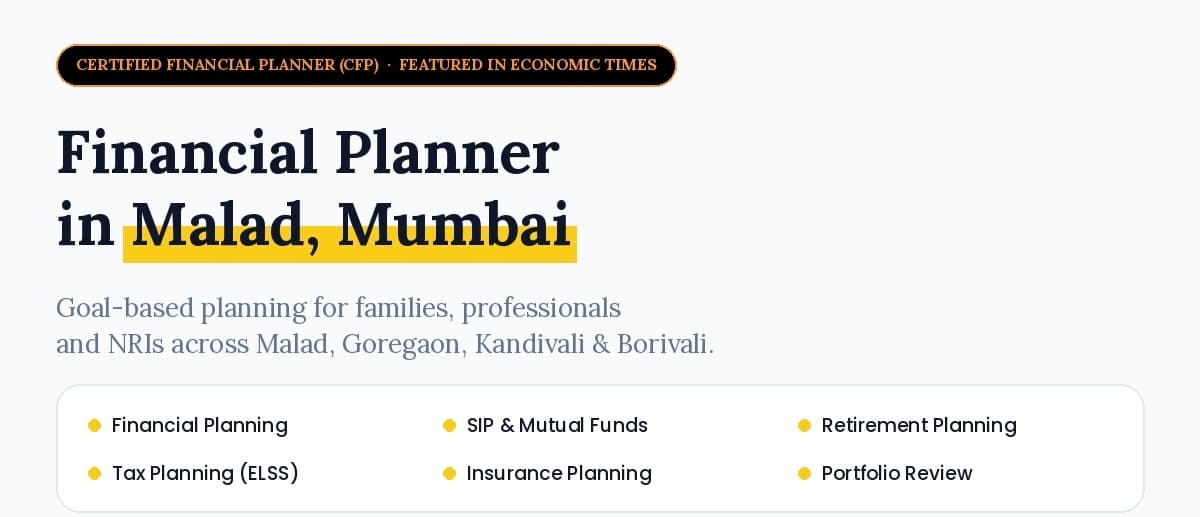
Looking for a trusted financial planner or financial consultant in Malad? Asset Elixir is led by Shivam Pathak, Certified Financial Planner (CFP), featured as an expert in Economic Times MutualFunds. Our Malad West office at Chincholi Phatak serves families and professionals across Malad, Goregaon, Kandivali, Borivali and Andheri. # Our Malad office {Address:} Shop 10, Rani Sati Nagar CHS, next to Vrindavan Restaurant and Bar, Chincholi Phatak signal, Swami Vivekanand Road, Malad West, Mumbai, Maharashtra 400064 {Timings:} Monday to Sunday, 9:00 AM to 10:00 PM {Call or WhatsApp:} +91 70210 89870 ('Get directions on Google Maps', 'https://www.google.com/maps/place/?q=place_id:ChIJzVd7vEu35zsRgcbMSOlLEpw') # Who we help [Salaried professionals working in Malad, Goregaon and Andheri who want a clear plan for their salary, SIPs and tax savings] [Business owners who need to separate business and personal wealth] [NRIs with family or investments in Mumbai] [Families planning for children's education, a new home or retirement] # Our services [{Financial Planning:} Goal-based plans for retirement, children's education and buying a home] [{Financial Consulting:} One-on-one guidance for salaried professionals, business owners and NRIs] [{Mutual Fund and SIP Advisory:} The right funds and SIP amounts for your goals and risk level] [{Retirement Planning:} How much you need to retire, and a step-by-step plan to get there] [{Tax Planning (ELSS):} Tax-saving investments under Section 80C that fit your long-term goals] [{Insurance Planning:} Making sure your family has the right life and health cover] [{Portfolio Review:} A full check of your existing investments, with a clear plan to fix gaps] # Why clients choose Asset Elixir [Certified Financial Planner (CFP) led advice] [Featured as an expert in Economic Times MutualFunds] [Goal-based planning with no pressure to buy any product] [Rated 5.0 on Google by our clients] [Offices in Malad, Vikhroli and Turbhe (Navi Mumbai)] # Book a consultation in Malad Visit our Malad West office near Chincholi Phatak, or start on WhatsApp. ('Chat with us on WhatsApp', 'https://wa.me/917021089870') Read our latest insights: ('Gold vs Silver ETFs: Is It Time to Rebalance?', 'ADD YOUR BLOG POST LINK HERE') ## Disclaimer Mutual fund investments are subject to market risks. Read all scheme-related documents carefully.

Gold ETF Inflows Fall 22%, Silver Jumps 57% in October: Is It Time to Rebalance Your Portfolio?
Market Insights
Nov 12, 2026| 5 min read

Gold ETF Inflows Fall 22%, Silver Jumps 57% in October: Is It Time to Rebalance Your Portfolio?

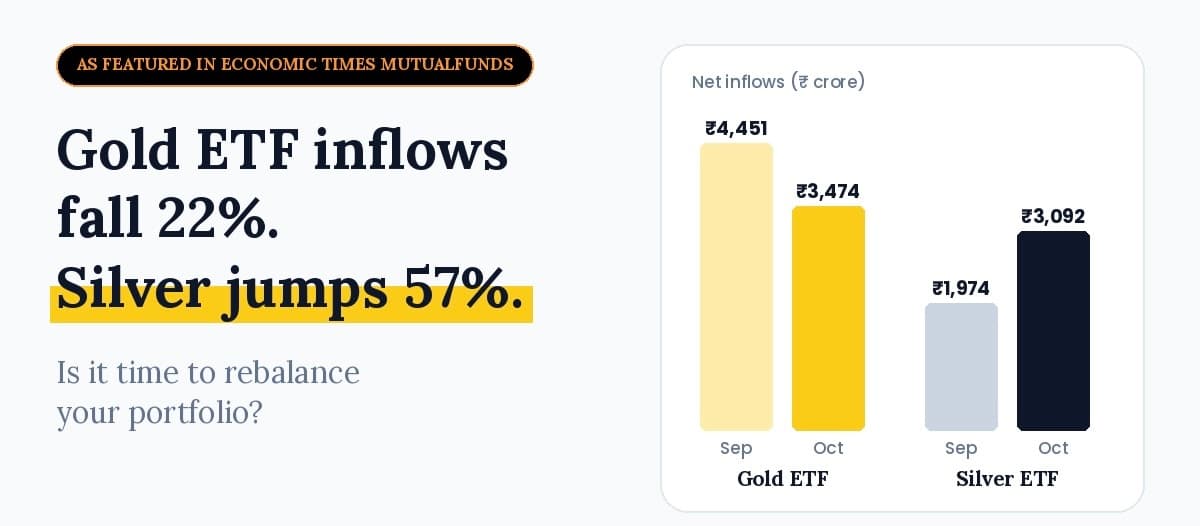
I recently shared my view on this topic in Economic Times MutualFunds. ('Read the original article on Economic Times', 'https://economictimes.indiatimes.com/mf/analysis/gold-etf-inflows-fall-22-but-silver-jumps-57-in-october-is-it-time-to-rebalance-your-portfolio/articleshow/135756127.cms'). In this post, I explain what these numbers mean for families and professionals in Navi Mumbai and Mumbai. # What happened in October As per AMFI data, gold ETFs received net inflows of ₹3,474 crore in October 2026, down about 22% from ₹4,451 crore in September. Silver ETFs went the other way, with inflows rising about 57% to ₹3,092 crore from ₹1,974 crore. Two things contributed. MCX gold prices corrected about 7% during the month, and from 16 October several fund houses paused fresh investments into gold and silver fund-of-funds schemes. Even after the fall, gold ETFs still received more money than silver ETFs. One month of data does not mean investors have moved away from gold. Money is moving from gold, which has had a strong run, into silver, which many investors see as the catch-up trade. # Why this matters for your portfolio When one asset rallies, it quietly takes a bigger share of your portfolio than you planned. A 10% gold allocation can become 15% without you buying a single unit. That changes your risk, even if you did nothing. Chasing the latest trend has the opposite problem. Silver is far more volatile than gold, and moving in after a big jump often means buying high. # How to decide whether to rebalance [{Check your target allocation:} Compare what you hold today with the plan you set for your goals. If precious metals are more than 5 percentage points above target, consider trimming.] [{Treat gold as insurance, not a return engine:} For most investors, 5–15% in gold works as a hedge against inflation, rupee weakness and equity falls.] [{Keep silver small:} If you want silver, a small slice inside your metals allocation is enough. Don't let it replace gold.] [{Rebalance on a schedule, not on news:} Once or twice a year, or when an asset drifts past your band, works better than reacting to monthly flows.] [{Watch tax and exit load:} Selling triggers capital gains. Where possible, rebalance using fresh SIP money instead of selling.] # The bottom line One month of inflows is not a reason to change your plan. It is a good reminder to check whether your portfolio still matches your goals. # Talk to a financial planner in Navi Mumbai or Mumbai Asset Elixir offers goal-based financial planning, SIP advisory and portfolio reviews from our offices in Turbhe (Navi Mumbai), Vikhroli and Malad. ('Book your portfolio review on WhatsApp', 'https://wa.me/917021089870') or call +91 70210 89870. ## Disclaimer Mutual fund investments are subject to market risks. Read all scheme-related documents carefully. This article is for education only and is not a personal recommendation.

The Right Way to Start Your Investment Journey in 2026
Investments
Oct 31, 2026| 5 min read

The Right Way to Start Your Investment Journey in 2026

If you’ve been thinking about investing but don’t know where to start, you’re not alone. Most people begin their financial journey with questions like — How much should I invest? Where do I invest? What if I lose money? The truth is, investing isn’t just about picking funds or stocks. It’s about building a disciplined plan that helps you reach your life goals — without stress, confusion, or constant worry about the market. You can find ("Asset Elixir on Google","https://share.google/rbXg4hJ2oiyoxkH4F") to view verified location details and client reviews. As a ("Certified Financial Planner","https://assetelixir.com/best-financial-planner-in-mumbai/"), I’ve seen one thing over and over again — when people invest with purpose and structure, results follow. So, if 2026 is the year you want to finally start investing the right way, here’s your guide. {1️⃣ Know Why You’re Investing} Before you think about where to invest, you must first decide why. Ask yourself: – Do I want to build wealth for the long term? – Am I saving for a specific goal like a home, child’s education, or early retirement? – Do I simply want to beat inflation and grow my savings? When you define your “why,” you create clarity — and that helps you make better choices. Example: If your goal is short-term (less than 3 years), you’ll need safer investments like debt funds. But for long-term goals (5+ years), equity-based options like SIPs are ideal. {2️⃣ Set a Realistic Investment Amount} Many people delay investing because they think they need large sums to begin. That’s a myth. Even ₹1,000 per month invested through a Systematic Investment Plan (SIP) can grow meaningfully over time. What matters is consistency. Start small, stay regular, and increase your amount gradually as your income grows. Remember — time in the market beats timing the market. {3️⃣ Choose the Right Investment Mix} Your investment portfolio should reflect your goals, risk appetite, and time horizon. A good starting mix can look like this: Time Horizon | Risk Level | Suitable Options ————-|————-|—————— Short-term (1–3 yrs) | Low | Debt Mutual Funds, Fixed Deposits Medium-term (3–5 yrs) | Moderate | Hybrid / Balanced Funds Long-term (5+ yrs) | High | Equity Mutual Funds, Index Funds If you’re unsure where you stand, seek professional advice. At Asset Elixir, we help clients create the right balance — not just based on returns, but on life goals and comfort level. {4️⃣ Avoid Common Investment Mistakes} Even experienced investors make mistakes that can derail their goals. Here are a few to avoid: ❌ Chasing short-term returns: Don’t fall for trending funds or market hype. ❌ Ignoring risk: Every investment carries risk — understand it before committing. ❌ No review: Review your portfolio at least once a year to stay aligned with your goals. ❌ Mixing goals: Keep separate investments for each goal — don’t use your retirement fund for a vacation. A disciplined investor doesn’t try to outsmart the market — they stay consistent. {5️⃣ Stay Patient and Let Compounding Work} Compounding is the most powerful concept in investing — and also the least understood. When you invest regularly and allow your returns to earn further returns, your wealth multiplies faster than you imagine. Here’s a simple example: If you invest ₹10,000/month at 12% average annual returns: – In 10 years, you’ll have ~₹23 lakh – In 20 years, that becomes ~₹99 lakh – In 25 years, it crosses ₹1.8 crore The difference isn’t just returns — it’s time and consistency. {6️⃣ Seek Guidance from a Certified Financial Planner} Financial planning is personal. What works for your friend or colleague may not work for you. A Certified Financial Planner (CFP) helps you: – Understand your current finances – Define realistic goals – Create a customized investment plan – Review and adjust regularly At ("Asset Elixir","https://assetelixir.com/financial-planning-anytime-anywhere-in-india/"), we believe that good advice pays for itself — in peace of mind, clarity, and long-term wealth creation. {7️⃣ The 2026 Mindset: Invest Smart, Not Fast} 2026 will be a year full of opportunities — from new IPOs and government initiatives to evolving financial products. But the best investment strategy will always be discipline over excitement. Don’t aim to get rich overnight. Aim to stay invested for decades. The earlier you start, the more time your money gets to grow. Remember, the goal isn’t to time the market — it’s to spend more time in it. {Final Thoughts} Your investment journey doesn’t need to be complicated. Start small, stay consistent, and focus on your goals. Financial freedom isn’t about luck — it’s about planning and patience. If you’re ready to take the first step towards confident investing, Book your free consultation with Asset Elixir today and let’s make 2026 your year of financial growth.

Should You Increase Your SIP or Repay Your Home Loan Faster?
Investments
Oct 23, 2026| 5 min read

Should You Increase Your SIP or Repay Your Home Loan Faster?

For many working professionals, a home loan and monthly SIPs are two of their biggest financial commitments. As income increases, an important question arises: should you use the extra money to invest more through mutual fund SIPs, or should you make additional home loan repayments? There is no universal answer. The right decision depends on your loan terms, investment horizon, risk tolerance, liquidity and other financial responsibilities. # 1. Understand the Cost of Your Home Loan Start by checking your outstanding loan amount, interest rate, remaining tenure and prepayment conditions. Additional repayments reduce the outstanding principal. Depending on your loan terms and how the lender applies the payment, this can reduce the interest you pay over the remaining loan period or shorten the repayment tenure. The benefit of prepayment is relatively predictable compared with market-linked investment returns, although the precise savings depend on your loan terms and repayment schedule. Check whether any applicable charges or conditions affect your decision. # 2. Understand the Risk of Investing Through SIPs A systematic investment plan, or SIP, allows you to invest a fixed amount regularly in a mutual fund. An SIP is a method of investing, not a guarantee of returns. The value of equity mutual fund investments can rise and fall, and returns over your investment period may be lower than expected or negative. If you invest for a long-term goal, market-linked investments may have a role in your financial plan. However, comparing an assumed mutual fund return with your home loan interest rate can be misleading if the investment return is uncertain. Avoid making the decision on the assumption that the market will always deliver more than the loan costs. # 3. Consider Your Time Horizon Your investment time horizon matters. If you have a long-term goal and can tolerate market volatility, continuing suitable long-term investments may be reasonable, depending on your overall financial position. If you are uncomfortable with debt, approaching retirement or concerned about future cash flow, reducing the loan may become a higher priority. Consider when you will need the money you invest. Money intended for a near-term expense should not automatically be placed in volatile investments just because the loan interest rate appears higher or lower than an expected return. # 4. Do Not Ignore Emergency Savings Before deciding between SIPs and additional repayments, consider whether you have enough money available for emergencies. Job changes, medical expenses, repairs or family responsibilities can create sudden cash needs. Money used to repay a loan may not be easily accessible again without borrowing. Maintaining a suitable emergency reserve can help you avoid redeeming investments at an unfavourable time or taking on additional debt when an unexpected expense arises. The appropriate reserve depends on your household expenses, job stability, dependants and insurance arrangements. # 5. Balance Both Goals Instead of Choosing Only One You may not need to direct every additional rupee towards just one option. Depending on your circumstances, you could continue appropriate SIPs while making some additional home loan repayments. For example, after accounting for emergency savings, insurance needs and essential expenses, you could allocate part of your monthly surplus to investments and part to reducing the loan. This is an illustration of a possible approach, not a recommendation for every borrower. The proportions should be based on your goals and financial capacity. # 6. Consider Taxes and Loan Terms Your decision may also be affected by applicable tax rules, the type of property, the loan structure and whether any tax deductions are available to you. Tax benefits should be evaluated based on your specific eligibility and the tax regime that applies to you. Do not assume that a home loan automatically provides the same tax benefit to every borrower. Review the actual numbers before making a large prepayment or changing your investment plan. # 7. Review the Decision as Your Life Changes The right balance at age 30 may not be the right balance at age 45. A change in income, family responsibilities, the outstanding loan balance or your retirement timeline can change your priorities. Review the loan and your investments together rather than making decisions in isolation. The aim is to build financial security while continuing to make progress towards your important goals. # Financial Planning in Malad and Western Mumbai For families managing a home loan, monthly investments and long-term goals, a structured financial review can help bring these commitments together. At Asset Elixir, led by {Shivam Pathak, CFP®}, the focus is on understanding your overall financial situation before evaluating how your savings can be allocated across different priorities. If you are unsure whether to increase your SIPs or repay your home loan faster, consider reviewing your cash flow, emergency savings, outstanding debt, investment horizon and future goals together. Learn more about ('financial planning with Asset Elixir', 'https://assetelixir.com/services#financial-planning') to understand how your different financial commitments can be assessed together. The goal is not simply to repay debt or maximise investments. It is to make a decision that fits your financial life. {Disclaimer:} This article is for educational purposes only and does not constitute individual investment, tax or loan advice. Mutual fund investments are subject to market risks. Read all scheme-related documents carefully.

How to Plan for Your Child's Education Without Compromising Retirement
Financial Planning
Oct 23, 2026| 5 min read

How to Plan for Your Child's Education Without Compromising Retirement

For many parents, their child's education is one of their most important financial goals. Whether the plan is for engineering, medicine, management or higher education abroad, the cost can be substantial. The challenge is to prepare for this expense without neglecting other important goals, especially retirement. The best way to approach this is to turn the goal into a financial plan with a clear timeline, an estimated cost and a suitable investment strategy. # 1. Estimate the Future Cost of Education Start by identifying the type of education you want to prepare for. Consider tuition fees, accommodation, travel, books and other expenses. If your child may study abroad, also consider currency fluctuations and the additional cost of living. Education expenses can rise over time. Therefore, the amount you would need if your child started college today may not be sufficient when the actual time arrives. For example, an education expense of ₹20 lakh today would become approximately ₹32.6 lakh in 10 years if the cost increased by 5% annually. This is only an illustration. Actual education costs can increase faster or slower depending on the course, institution, location and currency. # 2. Calculate How Much Time You Have Your investment strategy should reflect when the money will be needed. If your child is very young, you may have a longer period to build the required corpus. If your child is already in secondary school, you may have less time and a greater need to protect the money required in the near future. A longer time horizon may allow you to consider growth-oriented investments, depending on your risk capacity. As the goal approaches, it becomes increasingly important to evaluate market risk and the possibility of needing to withdraw money during a market decline. There is no single investment allocation suitable for every family. # 3. Work Out the Monthly Investment Required Once you have estimated the future cost and the time available, calculate how much you may need to invest regularly. Your existing investments for the education goal should also be included. This helps you avoid treating the entire target amount as if you were starting from zero. The calculation depends on the amount already accumulated, the time remaining and the return assumption used. Since investment returns are not guaranteed, it is sensible to test different scenarios rather than depend on one optimistic estimate. Review the required investment periodically as your income, expenses and the estimated education cost change. # 4. Do Not Put Every Financial Goal on Hold One common challenge for parents is deciding how to divide their savings between their child's education and their own retirement. It is understandable to prioritise your child's future. However, neglecting retirement completely can create financial pressure later. Your child's education has a defined timeline, while retirement may need to be funded for several decades. Both goals deserve attention. A financial plan can help you understand the trade-offs, set realistic priorities and determine how to allocate your available savings across different goals. # 5. Review Your Investments as the Goal Approaches A portfolio that was appropriate when your child was five may not be appropriate when your child is 16. As the goal approaches, review how much money is already available, how much is still required and how much risk you can reasonably afford to take. Avoid relying only on recent fund performance when deciding whether to change investments. The decision should reflect your remaining time horizon, the purpose of the money and the potential impact of a market decline. It may also be useful to keep money required in the near term separate from investments intended for goals further into the future. # 6. Keep the Plan Flexible Your child's plans may change. They may choose a different course, study in another city or pursue an opportunity you had not originally considered. Your financial plan should be reviewed as these decisions become clearer. Flexibility does not mean avoiding a target. It means reviewing assumptions and making adjustments when your circumstances or goals change. # Child Education Planning in Navi Mumbai Families in Navi Mumbai and surrounding areas can benefit from looking at education planning as part of their overall financial picture. At Asset Elixir, led by {Shivam Pathak, CFP®}, the focus is on understanding family goals, existing investments, available savings and the time required to achieve each objective. If you are preparing for your child's higher education, consider reviewing the expected cost alongside your retirement needs and other financial commitments. Explore our ('financial planning services', 'https://assetelixir.com/services#financial-planning') to learn how your family's financial goals can be organised into a structured plan. Planning ahead can give you more time to evaluate your options and make decisions with greater clarity. {Disclaimer:} This article is for educational purposes only and does not constitute individual investment advice. Future education costs and investment returns are uncertain. Mutual fund investments are subject to market risks. Read all scheme-related documents carefully.

How Much Money Do You Need to Retire in Mumbai?
Retirement
Oct 23, 2026| 5 min read

How Much Money Do You Need to Retire in Mumbai?

Retirement planning is not just about accumulating a large investment portfolio. It is about ensuring that your money can support the lifestyle you want after you stop working. For someone living in Mumbai, housing costs, healthcare, everyday expenses and family responsibilities can significantly influence how much money you may need. The important question is not simply, "How much should I save for retirement?" It is, "How much money will I need to meet my expenses throughout retirement?" # 1. Start With Your Current Monthly Expenses The first step is to understand how much your household spends today. Include: [Household expenses, groceries and utilities] [Housing costs and maintenance] [Medical expenses and health insurance] [Travel, hobbies and lifestyle expenses] [Support for children or other family members] [Annual expenses such as holidays and home repairs] Do not assume that your retirement expenses will automatically be lower than your current expenses. Some costs may reduce, but healthcare, travel and other expenses could increase. # 2. Account for Inflation Inflation can substantially increase the cost of living over a long period. For example, if your monthly expenses today are ₹1 lakh, they could rise to approximately ₹2.19 lakh after 20 years if inflation averages 4% annually. At 6% inflation, the same expenses could rise to approximately ₹3.21 lakh. These are illustrations, not predictions. Actual inflation will vary, and different expenses may increase at different rates. This is why retirement planning should consider future expenses rather than relying only on today's household budget. # 3. Estimate Your Retirement Corpus Your retirement corpus is the pool of money you build to support your retirement. The amount required depends on several factors: [Your expected retirement age] [Your estimated retirement expenses] [The number of years your retirement may last] [Your existing investments and other income sources] [Your expected investment returns and inflation] [Your healthcare needs and financial responsibilities] A calculation based only on annual expenses can be a starting point, but it is not a complete retirement plan. A proper estimate should consider investment growth, withdrawals, inflation and the possibility of market declines. # 4. Review Your Existing Investments Many investors accumulate investments gradually through mutual fund SIPs, provident fund contributions, pension benefits and other assets. However, having multiple investments does not automatically mean you are on track for retirement. Review whether your investments are aligned with your retirement timeline, whether your portfolio is overly concentrated and whether you have adequate liquidity for expenses that may arise before or during retirement. Your asset allocation should also be reviewed as your retirement date approaches. The appropriate balance depends on your individual circumstances and ability to handle risk. # 5. Do Not Ignore Healthcare and Emergency Needs Healthcare expenses can be difficult to predict, especially during retirement. Review your existing health insurance, understand its limitations and consider how you would manage expenses that are not covered by your policy. It is also important to maintain an appropriate emergency reserve rather than investing every available rupee for long-term growth. The aim is to build a retirement plan that can handle both expected expenses and financial surprises. # 6. Review Your Retirement Plan Regularly Your retirement plan should change as your circumstances change. A salary increase, a home purchase, a change in family responsibilities or a change in your expected retirement age may affect how much you need to invest. close. If there is a gap between your projected corpus andour may have time to adjust your savings rate, retirement date or expected spending. # Retirement Planning in Mumbai With Asset Elixir At Asset Elixir, led by {Shivam Pathak, CFP®}, the focus is on understanding a person's financial goals, existing investments and responsibilities before evaluating an investment strategy. If you are assessing whether your investments are sufficient for retirement, a structured review can help you understand where you stand and what may need attention. Explore our ('financial planning services', 'https://assetelixir.com/services#financial-planning') to learn more about how retirement planning fits into your broader financial goals. The earlier you understand your retirement requirements, the more time you have to make informed decisions. {Disclaimer:} This article is for educational purposes only and does not constitute individual investment advice. Calculations are illustrative. Mutual fund investments are subject to market risks. Read all scheme-related documents carefully.

Have A Financial Decision On Your Mind?

Whether you're planning for the future, reviewing your investments, or simply looking for a second opinion, we're here to help you think it through.